
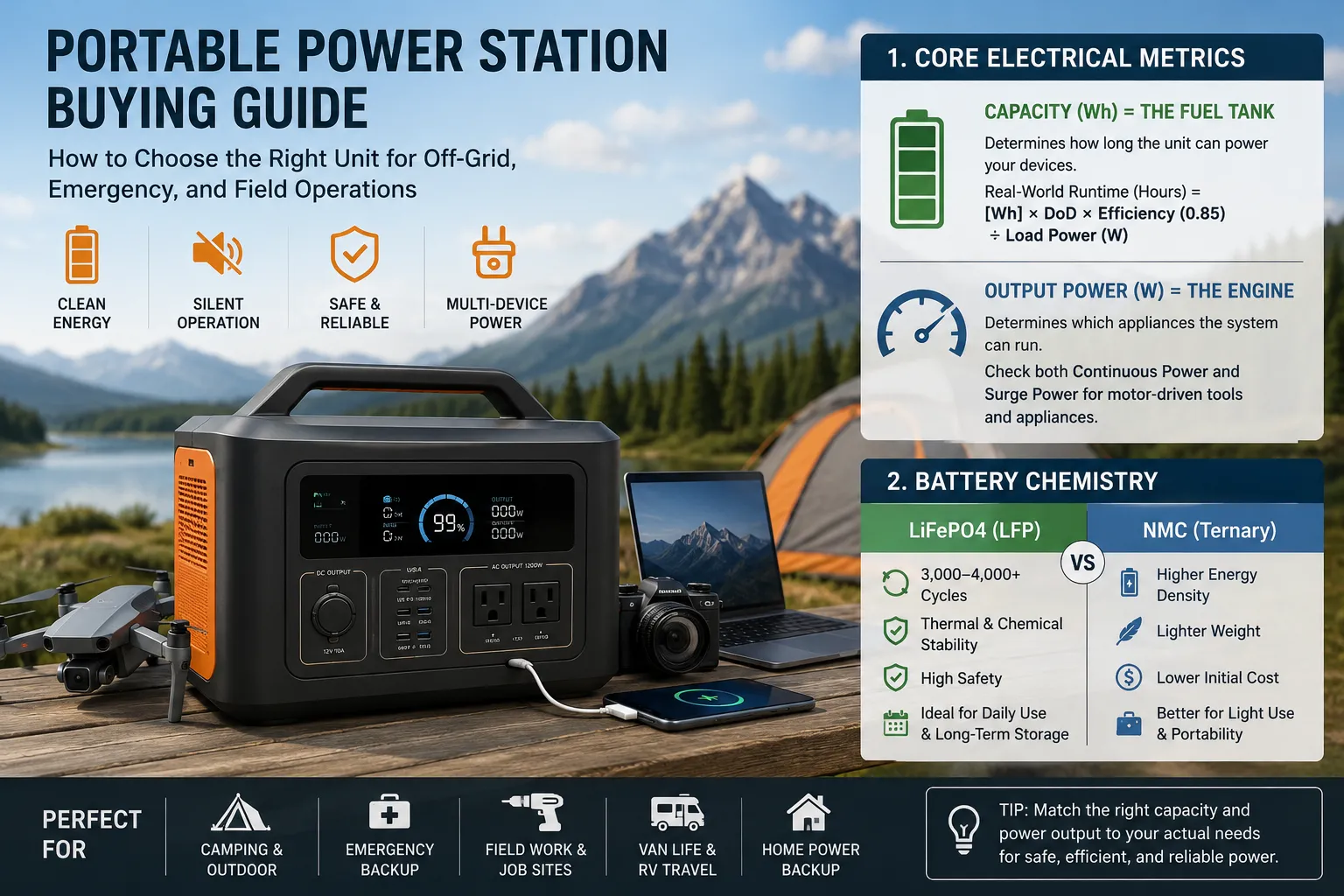
In an era defined by mobile workforces, off-grid job sites, outdoor expeditions, and increasingly frequent severe weather events that compromise municipal electrical grids, the demand for clean, silent, and autonomous power has surged. While traditional gas-powered generators historically served as the default backup solution, their extreme noise, toxic carbon monoxide emissions, and continuous maintenance liabilities have accelerated a massive transition toward battery-powered generators. For facility managers, field service engineers, and residential users evaluating portable energy assets, knowing how to choose a Portable Power Station is an essential exercise in electrical load analysis and lifecycle cost calculation.
A portable power storage system is far more than a high-capacity power bank. It is an integrated electrical generation and distribution ecosystem comprising high-density battery cells, a complex Battery Management System (BMS), a high-efficiency bi-directional power inverter, and multi-port direct current (DC) and alternating current (AC) delivery modules. Selecting the wrong unit can result in instant inverter overload, damaged electronic equipment, or premature cell failure in harsh environments.
This authoritative technical guide deconstructs the critical electrical parameters, internal chemistries, inverter topologies, and durability standards necessary to choose the optimal Portable Power Station for your specific commercial or residential deployment.
1. Core Electrical Metrics: Decoupling Capacity (Wh) from Output Power (W)
The most common mistake buyers make when procuring a mobile power asset is conflating battery capacity with inverter output power. These two metrics represent entirely different physical properties of the system and must be evaluated independently to ensure seamless operation.
Battery Capacity (Watt-Hours, Wh): The Fuel Tank
Battery capacity, measured in Watt-hours (Wh) or Kilowatt-hours (kWh), dictates how long the unit can power your connected devices on a single charge. It represents the total amount of energy stored within the electrochemical cell array. For example, a 1,000Wh power station running a 100W continuous load will theoretically provide 10 hours of runtime before accounting for efficiency losses.
However, practical engineering mandates factoring in the system’s depth of discharge (DoD) and inverter conversion efficiency. Most modern systems operate at approximately 85% to 90% real-world efficiency due to heat dissipation and internal parasitic loads. The formula for estimating true operational runtime is:
Real-World Runtime (Hours) = [Nominal Capacity (Wh) × Depth of Discharge × Inverter Efficiency (0.85)] ÷ Load Power Consumption (Watts)
Continuous Output Power vs. Surge Power (Watts, W): The Engine
While capacity determines duration, continuous output power (measured in Watts) dictates which specific tools and appliances the system can physically turn on. The built-in inverter converts the low-voltage DC electricity from the battery into standard 120V or 230V AC utility power. If your electrical appliances draw a cumulative total of 1,800W, a unit rated for only 1,200W continuous output will immediately trigger an over-current safety shutdown.
Furthermore, procurement engineers must evaluate surge or peak power. Inductive loads—appliances containing electric motors, compressors, or pumps (such as heavy-duty rotary tools, refrigerators, air conditioners, and air compressors)—require a massive instantaneous “inrush current” to overcome rotor inertia at startup. This inrush current can spike up to 2 to 3 times the tool’s continuous running wattage for several hundred milliseconds. A high-tier Portable Power Station must feature an inverter with a dynamic surge capability that can sustain these millisecond spikes without collapsing the output voltage.
2. Battery Chemistry: Lithium Iron Phosphate (LiFePO4) vs. Ternary (NMC)
The internal chemical composition of the battery cells forms the foundational baseline for the system’s operational lifespan, thermal safety, and gravimetric energy density. The market is primarily divided between Lithium Nickel Manganese Cobalt (NMC) and Lithium Iron Phosphate (LiFePO4 / LFP).
The Longevity and Safety of LiFePO4 (LFP)
For industrial, commercial, and intensive emergency preparedness applications, Lithium Iron Phosphate is the definitive engineering standard. LFP chemistry features an exceptionally stable olivine crystal lattice bonded by strong covalent phosphorus-oxygen (P-O) bonds. This chemical structure provides two decisive operational advantages:
- Unmatched Cycle Life: Premium LFP-based units routinely achieve 3,000 to 4,000 complete charge/discharge cycles before degrading to 80% of original capacity. For a user cycling the system daily, this equates to nearly 10 years of continuous service.
- Thermal Runaway Resistance: LFP cells have a thermal runaway threshold exceeding 270°C (518°F) and do not release oxygen when decomposed, virtually eliminating the risk of catastrophic fires under mechanical puncture, extreme ambient heat, or overcharging conditions as evaluated under UL 2743 safety standards for portable power packs.
The Portability Trade-Off of NMC
While ternary lithium (NMC) chemistry possesses a higher gravimetric energy density (meaning more Watt-hours per pound of physical weight), it suffers from a significantly shorter cycle life (typically 500 to 800 cycles to 80% capacity) and a lower thermal runaway threshold (around 150°C to 210°C). NMC remains viable for ultra-lightweight, casual backpacking gear, but for mission-critical reliability and lower Total Cost of Ownership (TCO), LFP is the superior industrial specification.
3. Inverter Topology and Power Quality: The Pure Sine Wave Mandate
The electrical current stored in battery cells is Direct Current (DC), but the vast majority of industrial tools, medical devices, and household appliances require Alternating Current (AC). The internal component responsible for this conversion within a Portable Power Station is the inverter. However, not all inverters produce the same quality of electricity. Procurement specialists must strictly evaluate the inverter’s output waveform.
Modified vs. Pure Sine Wave
Budget-tier power stations often utilize “Modified Sine Wave” inverters. These produce a blocky, stepped waveform that roughly approximates AC power. While sufficient for simple resistive loads like incandescent bulbs or basic resistive heaters, modified sine waves are highly destructive to sensitive electronics. They cause audio equipment to hum, force electric motors to run excessively hot (reducing their lifespan), and can instantly fry the delicate microprocessors in CPAP machines, servers, and modern telecommunications gear.
For any professional, medical, or high-end residential application, specifying a Portable Power Station equipped with a “Pure Sine Wave” (PSW) inverter is mandatory. PSW inverters produce a smooth, continuous waveform identical to—and often cleaner than—the electricity supplied by the municipal grid. When evaluating specifications, look for a Total Harmonic Distortion (THD) rating of less than 3% to guarantee absolute safety for sensitive electronics.
UPS Functionality and Transfer Times
Beyond off-grid operations, a primary use case for these systems is functioning as an Emergency Power Supply (EPS) or Uninterruptible Power Supply (UPS) for critical infrastructure. In this setup, the power station is plugged into the wall, and the sensitive equipment is plugged into the station. The power bypasses the battery and runs directly to the equipment until a grid blackout occurs.
The critical metric here is “transfer time”—the exact duration it takes for the system’s internal relays to switch from municipal power to battery power. According to the international standards outlined in IEC 62040-1 (Uninterruptible power systems – General and safety requirements), standard IT equipment requires a transfer time of under 20 milliseconds (ms) to prevent data loss or server crashes. Premium Portable Power Station models are engineered with transfer times of less than 10ms, ensuring that desktop computers, network attached storage (NAS) drives, and life-support medical devices remain operational without the slightest interruption.
4. Solar Harvesting Integration: The Critical Role of MPPT
The true autonomy of a portable energy system is defined by its ability to recharge independently of the municipal grid. While virtually all modern units accept solar input, the efficiency of that solar harvesting is entirely dictated by the internal solar charge controller. This component acts as the gateway between the solar panels and the internal battery array.
Maximum Power Point Tracking (MPPT) Explained
Historically, low-cost solar systems utilized Pulse Width Modulation (PWM) controllers, which essentially forced the solar panels to operate at the same voltage as the battery, sacrificing massive amounts of potential energy. Modern, commercial-grade Portable Power Station architectures utilize Maximum Power Point Tracking (MPPT) technology.
Solar panel voltage fluctuates wildly based on cloud cover, shading, temperature, and the angle of the sun. An MPPT controller is a highly advanced DC-to-DC converter that scans the solar array’s output multiple times per second. It autonomously adjusts the electrical resistance to find the exact “maximum power point”—the optimal combination of voltage and current—and then converts that high voltage down to the exact charging voltage required by the LFP battery. Industry data confirms that an integrated MPPT controller improves solar harvesting efficiency by up to 30% compared to legacy PWM technology, especially in low-light or cold-weather conditions.
| Engineering Metric | PWM (Pulse Width Modulation) | MPPT (Maximum Power Point Tracking) |
|---|---|---|
| Energy Conversion Efficiency | Low (Typically 65% – 75%) | Maximum (Up to 98% – 99%) |
| Voltage Handling | Panel voltage must closely match battery voltage. | Accepts massive voltage ranges; steps down intelligently. |
| Performance in Partial Shade | Severe power drop-off. | Dynamically adjusts to capture available energy. |
| Best Application Case | Budget, low-wattage, non-critical setups. | High-capacity systems, varied weather, commercial use. |
Actionable Advice: Evaluating Solar Input Limits
When selecting a unit for off-grid deployment, scrutinize the “Maximum Solar Input” specifications. A high-capacity 2,000Wh battery is useless in an off-grid scenario if its MPPT controller is bottlenecked at a maximum of 200W of solar input (which would require a minimum of 10-12 hours of perfect sunlight to recharge). Look for systems that support wide voltage ranges (e.g., 12V to 150V DC) and high amperage allowances, enabling you to string multiple high-wattage solar panels together in series or parallel to achieve rapid recharge times of under 3 hours.
5. Port Architecture, Expandability, and Build Engineering
Beyond the internal battery cells and inverter, the physical usability of a Portable Power Station is defined by its external interface and structural ruggedness. In field operations and emergency scenarios, the availability and distribution of specific output ports directly impact operational efficiency.
Port Diversity and High-Power DC Rails
A comprehensive output matrix must accommodate a wide array of legacy and modern electronic standards:
- High-Wattage USB-C Power Delivery (PD): Modern laptops, drones, and camera equipment charge rapidly via USB-C. Ensure the system features dedicated USB-C ports delivering up to 100W or 140W (USB PD 3.1) directly from the DC bus, eliminating the need to use an AC wall adapter and bypassing the 10%-15% conversion losses of running the internal AC inverter.
- Regulated 12V DC Car Ports and Anderson Powerpoles: Unregulated 12V outputs drop in voltage as the battery discharges, which often triggers premature low-voltage shutdowns on 12V portable refrigerators. A regulated 12V output provides a constant 13.6V until the battery is entirely depleted. For RV enthusiasts and off-grid radio operators, a high-amperage (30A) Anderson Powerpole port is essential for powering high-draw 12V appliances directly.
- High-Current AC Outlets: High-capacity units (2,000Wh+) should feature standard 15A/20A AC receptacles alongside a dedicated 30A NEMA TT-30R outlet, allowing direct plug-in capability for RVs or transfer switches connected to home breaker panels.
Modular Battery Expandability
A major advancement in portable power engineering is modular scalability. Rather than buying an excessively heavy all-in-one unit that is difficult for a single person to lift, modern architectures allow users to purchase a base unit (e.g., 2,000Wh) and connect modular expansion battery packs via high-voltage DC cables. This modularity allows the system to scale from 2kWh for weekend field expeditions up to 10kWh+ to serve as a comprehensive whole-home backup during multi-day grid outages.
B2B Selection Matrix: Matching Power Stations to Practical Applications
To streamline the procurement and evaluation process, the following selection matrix matches distinct operational profiles with their required electrical and mechanical specifications.
| Use Case Profile | Target Capacity (Wh) | Inverter Continuous Power (W) | Ideal Chemistry | Key Architectural Features |
|---|---|---|---|---|
| Ultralight / Field Photography | 300Wh – 600Wh | 300W – 600W | NMC or LFP | Compact weight (<15 lbs), 100W USB-C PD, silent passive cooling. |
| Vanlife / Off-Grid Camping | 1,000Wh – 2,000Wh | 1,000W – 2,000W | LiFePO4 (LFP) | Regulated 12V/10A port, 500W+ MPPT solar input, Pure Sine Wave inverter. |
| Construction & Field Service | 2,000Wh – 3,500Wh | 2,400W – 3,600W (High Surge) | LiFePO4 (LFP) | Ruggedized outer casing, 30A outlet, rapid 1-hour AC wall recharging. |
| Whole-Home Emergency Backup | 3,000Wh – 10,000Wh+ (Modular) | 3,000W – 6,000W | LiFePO4 (LFP) | Sub-10ms UPS transfer time, modular expansion ports, split-phase 240V support. |
Conclusion: The Definitive Procurement Framework
Choosing the ideal Portable Power Station is a structured engineering decision that hinges on balancing continuous electrical load demands, inductive startup surges, cycle life economics, and recharge logistics. By prioritizing long-lasting Lithium Iron Phosphate (LiFePO4) chemistry and mandating a Pure Sine Wave inverter with low total harmonic distortion, users ensure that both the power station and their sensitive downstream electronics are protected for thousands of operational cycles.
Furthermore, evaluating integrated Maximum Power Point Tracking (MPPT) capabilities and fast transfer times unlocks true off-grid independence and reliable backup protection during severe weather and grid collapse events. When specified with rigorous attention to these core parameters, a modern portable power asset delivers clean, quiet, and resilient power wherever mission-critical operations demand.
Frequently Asked Questions (FAQ)
What is the difference between a portable power station and a solar generator?
Mechanically, a portable power station and a solar generator are virtually identical. The term “solar generator” is primarily a marketing designation used when a portable power station is bundled together with compatible photovoltaic (PV) solar panels. Both systems utilize an integrated battery array, a Battery Management System (BMS), an internal solar charge controller (MPPT), and an AC inverter to supply off-grid electrical power.
Can a portable power station run a full-size home refrigerator during a power outage?
Yes. A modern, energy-efficient household refrigerator typically consumes between 100W and 200W of continuous running power, but requires an initial startup surge of 800W to 1,200W to engage the compressor. A power station with a minimum capacity of 1,000Wh to 2,000Wh and an inverter capable of sustaining at least 1,500W surge output can reliably power a standard refrigerator for 12 to 24 hours on a single charge.
Is it safe to leave a portable power station plugged into the wall continuously?
Yes, provided the unit is engineered with an advanced Battery Management System (BMS) and dedicated Pass-Through / UPS bypass circuitry. In premium units, when the battery reaches 100% state of charge, the incoming AC electricity automatically bypasses the battery cells and powers the connected devices directly. This eliminates continuous micro-cycling and prevents premature chemical degradation of the internal cells.