
Environmental Protection First: The Ecological Imperative of Modern Power
Before dissecting the electrical engineering and hardware specifications of decentralized power grids, the global transition in energy infrastructure must be framed by its primary driver: environmental protection. The modern industrial sector is undergoing a massive decarbonization mandate. For decades, remote industrial operations relied exclusively on heavy fossil fuels, releasing immense volumes of carbon dioxide (CO2), nitrogen oxides (NOx), and particulate matter into the atmosphere.
Today, corporate environmental philosophy dictates that sustainable operations are no longer optional. The integration of renewable energy sources—such as photovoltaic (PV) solar and wind—directly into heavy industrial processes is a critical step in achieving global net-zero emissions targets. By actively reducing reliance on localized diesel generation and mitigating the transmission losses inherent in long-distance power distribution, localized energy networks actively protect local ecosystems while drastically shrinking the corporate carbon footprint. This ecological vision forms the foundational architecture of the modern decentralized energy movement.
Defining the Architecture: What is a Microgrid System?
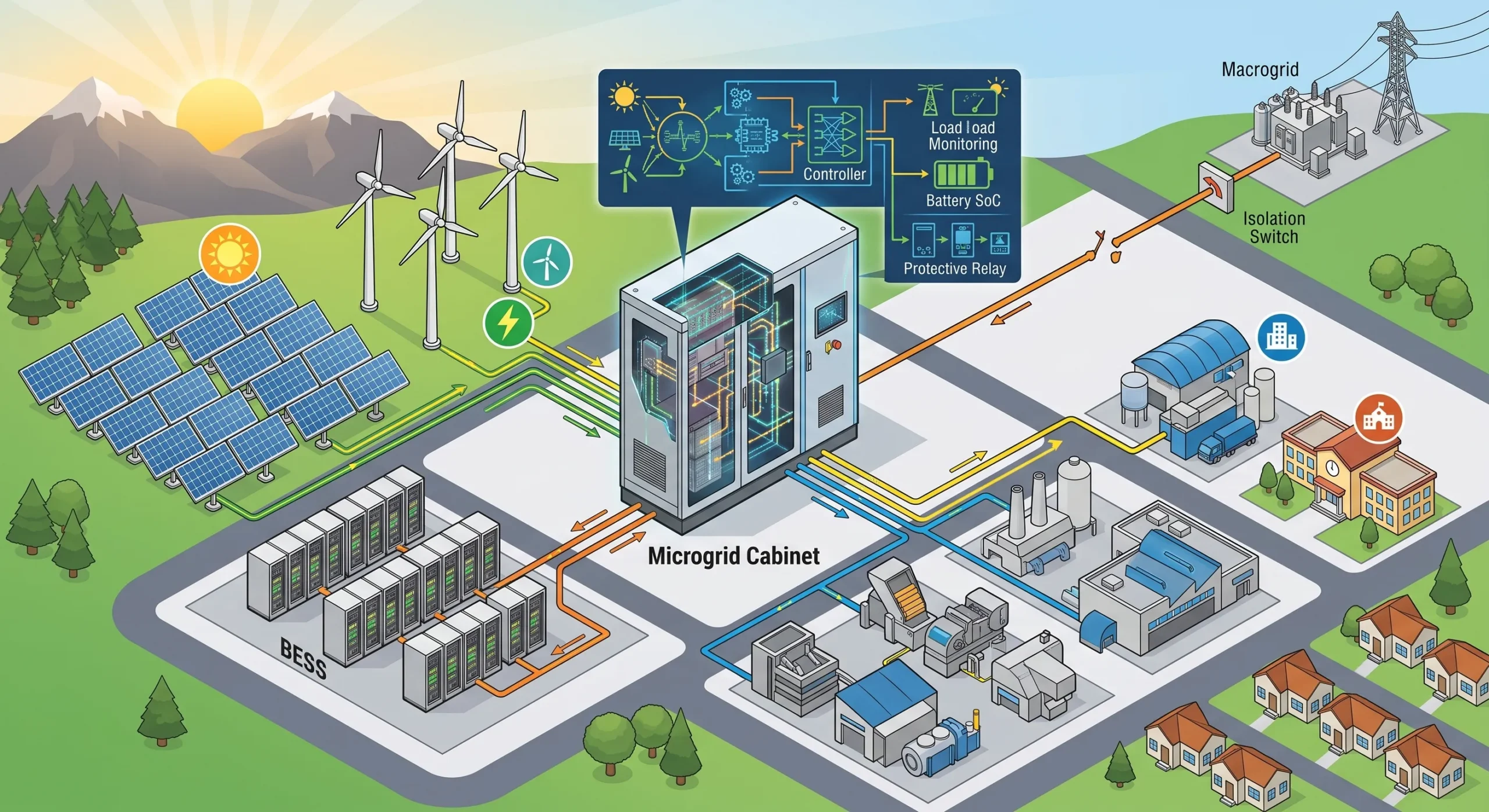
At its core, a microgrid system is a localized, self-contained energy grid capable of generating, storing, and distributing electrical power to a specific geographic footprint or industrial facility. Unlike a traditional macrogrid, which transmits power from massive, centralized power plants over hundreds of miles, a microgrid generates power close to the point of consumption.
The defining technical characteristic of a microgrid system is its dual-mode capability. According to the standards set by the Institute of Electrical and Electronics Engineers (IEEE), a true microgrid must be able to operate in both “grid-connected” mode (synchronizing with the larger utility grid to draw or export power) and “island” mode. If the main utility grid experiences a blackout due to extreme weather or capacity failures, the microgrid autonomously disconnects—a process known as islanding—and utilizes its own Distributed Energy Resources (DERs) to maintain uninterrupted power to the facility.
The DERs within this network typically include a hybrid combination of solar PV arrays, wind turbines, Battery Energy Storage Systems (BESS), and, when necessary for absolute redundancy, backup diesel or natural gas generators. However, coordinating these disparate power sources requires a highly sophisticated central nervous system.
The Role of the Microgrid Cabinet: The Operational Brain
A microgrid cannot function merely by wiring solar panels and batteries together; the varying voltages, frequencies, and direct current/alternating current (DC/AC) profiles would instantly destabilize the network and destroy connected industrial equipment. The critical hardware that manages, synchronizes, and protects this localized network is the Microgrid Cabinet.
The Microgrid Cabinet is a specialized, heavily engineered industrial enclosure that houses the Energy Management System (EMS), the Microgrid Controller, advanced switchgear, and critical protective relays. It acts as the intelligent hub of the entire system. When solar production peaks at noon, the controllers within the cabinet automatically direct the inverter to route excess DC power into the battery storage system. When a heavy industrial motor starts and causes a sudden spike in electrical demand, the cabinet instantaneously commands the battery to discharge, shaving the peak load and stabilizing the microgrid’s frequency.
Critical Components Within the Cabinet
- Microgrid Central Controller (MGCC): The algorithmic brain. It continuously monitors load demand, renewable generation, and battery State of Charge (SoC). It executes millisecond-level decisions on whether to draw from the grid, discharge batteries, or curtail solar output.
- Protective Relays and Switchgear: Ensures electrical safety. In the event of a macrogrid short circuit or voltage sag, the relays within the Microgrid Cabinet trigger the isolation breakers, physically islanding the local facility to protect it from external electrical faults.
- Power Quality Meters: Continuously analyzes Total Harmonic Distortion (THD) and power factor, ensuring that the electrical sine wave delivered to sensitive industrial equipment remains perfectly stable.
Without this central coordinating hardware, a localized energy system is merely a collection of stranded assets. The cabinet ensures interoperability, code compliance, and absolute thermal and electrical safety.
Heavy Industrial Applications: The Hybrid Mining Case Study
To fully grasp the operational impact of a localized power network, one must examine its deployment in the most demanding industrial environments. Extractive industries, specifically remote mining operations located across the African continent, represent the ultimate stress test for power reliability. Historically, these mining facilities operated on a fragile and highly inefficient energy model, relying on a volatile combination of unstable local utility grids supplemented by massive, carbon-intensive diesel generators.
The modern engineering solution is the deployment of a hybrid solar-and-grid industrial energy storage project. By integrating high-capacity Battery Energy Storage Systems (BESS) alongside expansive solar photovoltaic arrays, facility operators fundamentally transform the energy profile of the mine. However, merging a weak local grid, intermittent solar energy, chemical battery storage, and legacy diesel generators into a single, cohesive power source requires flawless algorithmic orchestration.
In these extreme off-grid or weak-grid environments, the Microgrid Cabinet serves as the definitive operational linchpin. When the local utility grid experiences a sudden voltage collapse (brownout) or total failure, the high-speed sensors within the cabinet detect the anomaly in milliseconds. The controller instantly commands the switchgear to isolate the mine’s electrical network from the failing macrogrid. Simultaneously, it routes power from the BESS to maintain continuous operation of heavy crushers and ventilation shafts, entirely avoiding the massive revenue losses associated with production downtime. The cabinet’s logic controllers will only signal the diesel generators to fire if the battery state of charge (SoC) drops below a strict, pre-programmed critical threshold, thereby slashing diesel consumption and operating costs.
Architectural Comparison: Macrogrid vs. Decentralized Systems
For Engineering, Procurement, and Construction (EPC) developers evaluating energy infrastructure, comparing the technical parameters of traditional grid reliance against a dedicated localized system highlights the extreme advantages of decentralization.
| Engineering Metric | Traditional Macrogrid (Centralized) | Localized Microgrid System |
|---|---|---|
| Resilience to External Faults | Low (Vulnerable to cascading regional blackouts and weather events) | Superior (Autonomously islands and sustains local loads) |
| Transmission Efficiency | Poor (High energy losses due to long-distance high-voltage transmission) | Excellent (Power is generated directly at the site of consumption) |
| Renewable Integration | Complex (Often requires massive grid-scale upgrades to handle volatility) | Optimized (Directly captures solar/wind and stores it in local BESS) |
| Power Quality Control | Variable (Subject to regional voltage sags and frequency shifts) | Strict (Inverters actively filter and stabilize the internal sine wave) |
B2B Procurement Strategy: Securing the Supply Chain
Procuring the infrastructure for a hybrid energy project is a highly complex logistical undertaking. The structural integrity, thermal management systems, and proprietary controllers housed within a Microgrid Cabinet must be perfectly matched to the specific voltage requirements and environmental conditions of the deployment site.
In the B2B industrial equipment sector, relying on fragmented supply chains introduces unacceptable risk. Procurement directors must specify that all critical energy storage components and control cabinets are shipped directly from the manufacturing factory. Traditional distribution models that route sensitive power electronics through third-party warehouses severely compromise the integrity of the hardware. Prolonged storage in unconditioned warehouses exposes sensitive circuit boards and battery modules to extreme humidity and temperature fluctuations, degrading their operational lifespan before they are even installed.
Consolidating procurement through an integrated supplier guarantees a direct factory-to-site pipeline. This not only ensures that the equipment bypasses the physical risks of intermediate warehousing but also drastically compresses project lead times and eliminates arbitrary distributor markups, thereby protecting the capital efficiency of the entire energy deployment.
Interoperability Standards and Communication Protocols
A decentralized energy network is an ecosystem of diverse technologies—inverters from one manufacturer, battery modules from another, and diesel generators from a third. For the Microgrid Cabinet to effectively synchronize these disparate assets, strict adherence to industrial communication protocols is mandatory. Procurement engineers must verify the software interoperability standards of the central controller before deployment.
The IEC 61850 Standard
In utility-grade and large-scale industrial microgrids, the prevailing global standard for communication is IEC 61850. Originally designed for substation automation, this protocol allows the Microgrid Cabinet to achieve ultra-fast, object-oriented data mapping. Unlike legacy polling protocols, IEC 61850 utilizes GOOSE (Generic Object Oriented Substation Event) messaging. This enables protective relays and inverters to exchange critical safety data in less than 4 milliseconds, ensuring immediate isolation during grid faults and preventing catastrophic equipment damage.
Modbus TCP/IP and DNP3 Integration
For integrating legacy equipment, such as older diesel generators or basic weather stations, the cabinet’s gateway must natively support Modbus TCP/IP and DNP3 (Distributed Network Protocol). These protocols allow the Energy Management System (EMS) to aggregate real-time data on engine temperature, fuel levels, and solar irradiance, utilizing this telemetry to execute predictive curtailment or dispatch commands.
Conclusion: The Decentralized Energy Future
Defining a microgrid system requires looking beyond individual solar panels or battery racks; it is the sophisticated integration of generation, storage, and intelligent control designed to operate autonomously from the centralized macrogrid. By generating power at the source of consumption, industrial facilities radically increase their resilience against rolling blackouts while achieving critical decarbonization targets.
The operational success of this infrastructure relies entirely on the precise engineering of the Microgrid Cabinet. Serving as the electrical and algorithmic core, it executes the rapid load balancing, fault isolation, and frequency stabilization required to keep heavy industrial operations running flawlessly. For EPC contractors and industrial developers, sourcing these critical control systems—and their associated battery assets—directly from the factory line ensures maximum hardware integrity, bypassing the severe degradation risks associated with volatile third-party warehouse storage. The future of industrial power is decentralized, autonomous, and meticulously controlled.
Frequently Asked Questions (FAQ)
What is the difference between a microgrid and a standard grid-tied solar system?
A standard grid-tied solar system automatically shuts down during a utility power outage to prevent back-feeding electricity into the grid and endangering line workers. A microgrid system features specialized switchgear and a central controller (typically housed in the control cabinet) that safely disconnects the facility from the utility and immediately utilizes its own battery storage and solar assets to maintain continuous power.
Can a microgrid operate entirely without diesel generators?
Yes, achieving a 100% renewable microgrid is mechanically feasible by massively over-sizing the solar photovoltaic arrays and the Battery Energy Storage System (BESS). However, for mission-critical industrial applications—such as underground mining ventilation—a diesel generator is often retained strictly as a tertiary, emergency backup to ensure absolute operational redundancy during prolonged periods of extreme weather or low solar irradiance.
Why is a centralized control cabinet necessary if modern inverters have built-in logic?
While modern string and central inverters possess internal logic for basic Maximum Power Point Tracking (MPPT) and self-protection, they lack the capacity to orchestrate an entire network of disparate assets. The central cabinet acts as the master controller, balancing the load demand of the facility against battery degradation algorithms, generator fuel curves, and real-time utility pricing, executing macro-level decisions that individual inverters cannot process.