
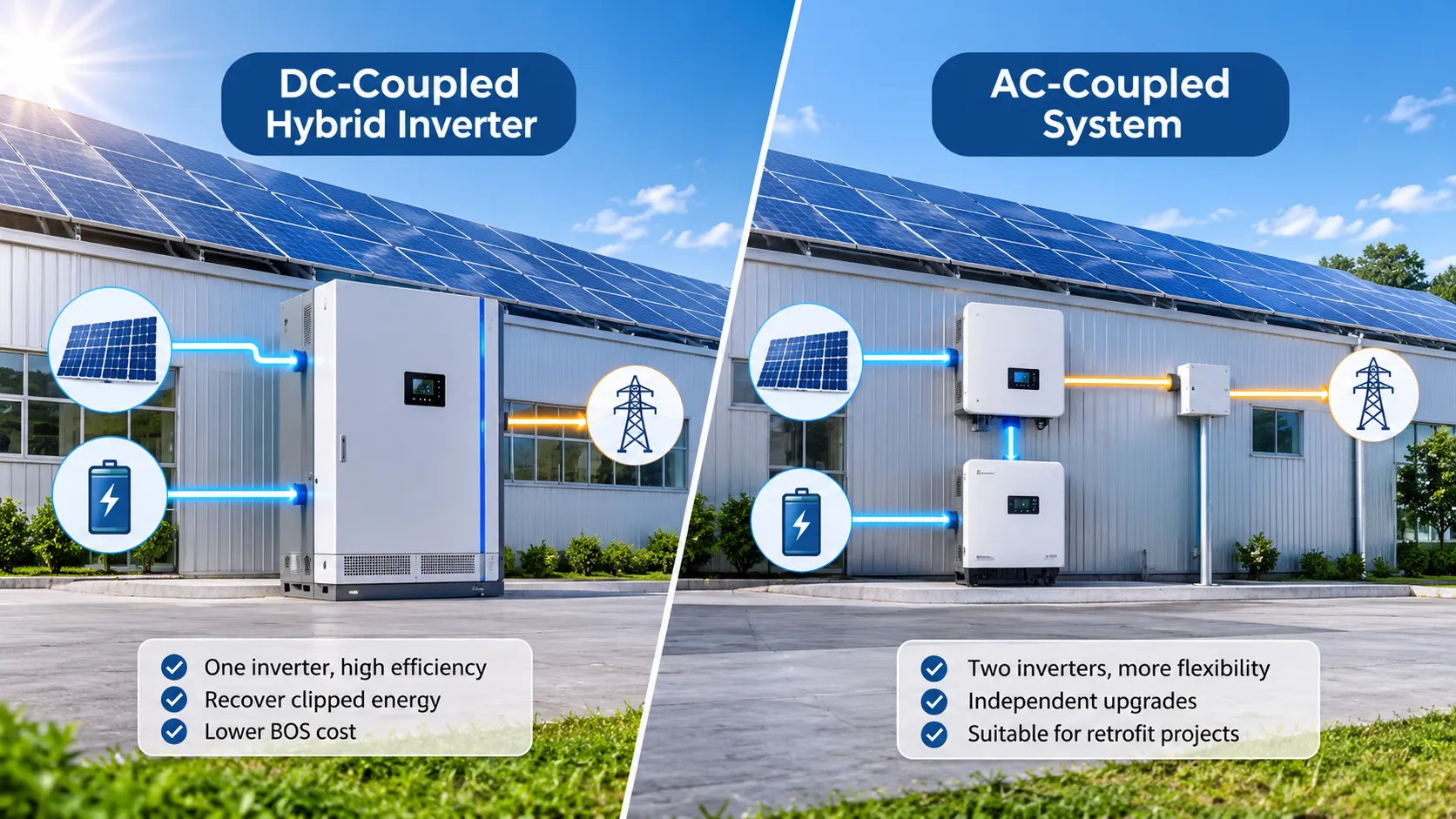
Adding battery storage to a commercial PV system forces one architectural decision before any product is chosen: does the battery share a hybrid inverter with the solar array (DC-coupled), or does it get its own battery inverter on the AC bus (AC-coupled)? Both architectures are mature, certified, and widely deployed — but they win in different projects, and choosing the wrong one costs real money in efficiency, interconnection, and lost flexibility.
This guide compares the two on the numbers that decide commercial projects: round-trip efficiency, clipping recovery, interconnection cost, retrofit complexity, and dispatch independence — with field data from utility-scale research and the certification framework both must satisfy.
How the Two Architectures Actually Differ
The distinction is about where energy changes form. In a DC-coupled system, the PV array and battery share one hybrid solar inverter on a common DC bus: energy harvested by the array can charge the battery directly, with no intermediate conversion. In an AC-coupled system, the PV array keeps its own inverter and the battery gets a second, dedicated inverter; the two meet only at the AC point of common coupling. That single difference cascades into every performance and cost figure below.
It also changes what the hardware looks like on site. A hybrid installation is one certified power cabinet handling PV, battery, and often backup loads, with high-voltage DC battery architecture that keeps cable cross-sections modest. An AC-coupled installation is two power conversion devices with two sets of protection, metering, and communications — more wall space and more commissioning steps, but also two units that can be specified, upgraded, and replaced on independent schedules. Whether that modularity is an asset or an overhead is the thread running through the rest of this comparison.
Round-Trip Efficiency: The Three-Conversion Problem
Storing PV energy through an AC-coupled battery takes three conversions: the PV inverter converts DC to AC, the battery inverter rectifies AC back to DC for charging, and on discharge the battery inverter converts DC to AC again. The hybrid path needs one. The measured consequence, compiled in the HTW Berlin Energy Storage Inspection 2025 benchmarking, is a round-trip efficiency of roughly 88–92% for AC-coupled systems against 92–96% for DC-coupled hybrids.
One important exception: grid charging is symmetric. When the battery charges from the grid at night, both architectures perform the identical single AC-to-DC conversion, and the efficiency difference effectively disappears. For projects whose revenue model is mostly tariff arbitrage rather than solar self-consumption, the efficiency penalty of AC coupling is largely irrelevant — a point many comparisons omit.
The cost of the gap is computable. At 300 kWh of daily PV-to-battery throughput, a 5% efficiency disadvantage wastes about 15 kWh per day; over a 250-day operating year at $0.15/kWh, that is roughly $560 per year. Real money over a ten-year project — but not, on its own, enough to justify replacing a working inverter on an existing array. Sizing the solar inverter and battery as one matched system also lets the hybrid design keep conversion losses low at partial load, where AC-coupled systems double up their standby overhead across two devices.
Where the Hybrid Architecture Wins
For new-build commercial projects, DC coupling on a hybrid solar inverter takes four decisive arguments — and each one compounds the others over a twenty-five-year asset life:
- Clipping recovery. Energy an oversized array would lose to inverter clipping can be routed into the battery instead. Field modeling puts recovery near 90% of clipped energy at a 1.5:1 DC/AC ratio, and capturing clipped energy alone can add 5–8% to annual revenue. A conventional solar inverter in an AC-coupled layout simply burns that surplus as heat at the array.
- Higher DC/AC ratios. DC-coupled configurations accept array-to-inverter ratios up to about 2.5 per manufacturer white papers, against the 1.3–1.5 typical where clipping has nowhere to go — more panels per inverter, lower balance-of-system cost.
- Single point of interconnection. One point of common coupling instead of two avoids a separate interconnection study — a saving variously estimated at $50,000–$150,000 per project — and shared infrastructure cuts capital cost roughly 10–20%.
- Efficiency that scales with storage. A peer-reviewed study of a 288 MWp PV plant with 275 MWh of storage, published in MDPI Energies, found DC coupling with a battery-side DC-DC converter delivered the highest annual average efficiency of all layouts — and the advantage grows as the BESS/PV energy ratio increases toward the ~20% sweet spot.
Where AC-Coupled Architecture Wins
For retrofits and flexibility-driven projects, the separate-inverter layout flips the argument — and these are the cases where a second, dedicated unit alongside the existing solar inverter outperforms any all-in-one design:
- Retrofit without re-engineering. Adding AC-coupled storage to an existing array leaves the PV side untouched: no inverter replacement, no voided warranties, no production downtime, and typically 10–15% lower installation labor than a DC-coupled retrofit. For plants installed between 2018 and 2022, it is almost always the right path.
- Dispatch independence. The battery inverter responds to its own controller, so a VPP aggregator or grid-services provider can dispatch storage without touching solar production. Hybrid systems route both resources through one control stack, which can constrain simultaneous solar export and grid dispatch.
- Redundancy and vendor freedom. Two independent inverters mean no single point of failure, and equipment from different manufacturers can be mixed — a hedge against the vendor lock-in of a matched hybrid solar inverter and battery platform.
- Frequency-regulation performance. A battery inverter dedicated to grid response reacts faster than a shared unit balancing two priorities, which matters in ancillary-service markets. It also ages on its own maintenance schedule: when one unit needs service, the other resource keeps earning while the fleet waits.
| Criterion | Hybrid (DC-coupled) | AC-coupled | Winner |
|---|---|---|---|
| Round-trip efficiency (PV charging) | 92–96% | 88–92% | Hybrid |
| Clipped-energy recovery | Yes (~90% at 1.5:1) | No | Hybrid |
| Max DC/AC ratio | Up to ~2.5 | Typically 1.3–1.5 | Hybrid |
| Interconnection cost | Single PCC (saves $50k–$150k) | Two studies, two PCCs | Hybrid |
| Retrofit to existing PV | Inverter replacement, warranty risk | Plug-and-play, warranties intact | AC-coupled |
| Independent battery dispatch / VPP | Constrained by shared control | Full independence | AC-coupled |
| Grid-charging efficiency | Equal (single conversion) | Equal (single conversion) | Tie |
| Redundancy | Single inverter = single failure point | Two independent units | AC-coupled |
Certification: What Both Architectures Must Clear
Architecture does not change the compliance baseline. In North America, the complete system needs listing to UL 9540 — whose third edition, published in 2025, now evaluates the battery ESS separately from the power conversion equipment — while the inverter itself must carry UL 1741 SB certification demonstrating conformance to IEEE 1547-2018 for ride-through, voltage and frequency support, and anti-islanding. The safety baseline for the power stage is set by IEC 62109-1, and installations fall under NFPA 855 and NEC Article 706. The practical difference: in a hybrid system the certified pairing of inverter and battery is tighter — under UL 9540 Edition 2 the exact pairing had to appear on one certificate — while AC coupling’s separation of certified components is what enables the vendor flexibility described above. Verify the specific evaluated pairing either way; component certificates alone do not satisfy AHJs.
Cost Structure: Where the Money Moves
The capital accounts tell the same story as the efficiency accounts, in mirror image. A hybrid system amortizes one power conversion stage across two jobs, so its inverter cost per kilowatt of capability is lower, its balance-of-system is smaller, and its interconnection is a single study. Industry estimates put the combined saving from shared infrastructure and single-point interconnection at 10–20% of capital cost, with the interconnection line item alone worth $50,000–$150,000 on commercial projects in study-heavy jurisdictions.
AC coupling pays that premium deliberately, and buys four things with it. First, no inverter replacement on retrofit projects — on a plant installed five years ago, the existing solar inverter may be half-way through its service life, and scrapping it to gain three efficiency points is rarely economic. Second, procurement freedom: battery and inverter can be tendered to different vendors, and either can be upgraded when technology moves. Third, operational redundancy: one failed unit does not strand the other resource. Fourth, faster permitting in some markets, because the storage scope sits on its own metering and its own application. Which of these matters is a project question, not a technology question — which is exactly why the architecture decision resists a universal answer.
The Decision Framework for a Commercial Project
Run the five questions in order; the first “yes” usually decides it:
- Is storage being added to an existing, performing PV plant? If yes, AC coupling — protecting warranties and production beats every efficiency argument.
- Is the project greenfield with a high DC/AC ratio planned? If yes, hybrid — clipping recovery converts an inherent loss into revenue.
- Is the revenue stack dominated by tariff arbitrage with night charging? The efficiency gap vanishes; decide on interconnection and redundancy instead.
- Does the site participate in VPP or ancillary-service markets? AC coupling’s independent dispatch becomes an asset; model the revenue it unlocks.
- What is the BESS-to-PV energy ratio? Around 20–35% for commercial peak shaving, the DC-coupled efficiency advantage is at its widest; below ~15%, architecture matters far less than sizing.
A multi-port hybrid solar inverter — accepting PV, battery, generator, and grid inputs with software-managed priority — is the emerging middle path for sites needing diesel backup as a third source, trading higher per-kW cost for eliminated transfer switching.
A worked example shows the framework in action. Take a 500 kW rooftop array built in 2020, now adding 250 kWh of storage for demand-charge management: the architecture question is already answered by the array’s existence — AC coupling preserves the installed equipment, and the nightly grid-charging mode means the round-trip gap costs almost nothing. Now take a greenfield 1 MW plant designed with a 1.5:1 array ratio and a 300 kWh battery: the hybrid path recovers roughly 90% of what would otherwise be clipped energy, avoids a second interconnection study, and starts life 10–20% cheaper on capital. Same product category, opposite answer — which is the entire point of running the framework instead of choosing by habit. The one constant across both cases is that the solar inverter selection should follow the architecture decision, not lead it, because the certified pairing between inverter and battery is what the AHJ will inspect.
Frequently Asked Questions
Is a hybrid solar inverter more efficient than AC coupling? For PV-to-battery charging, yes: measured round-trip efficiency runs roughly 92–96% for DC-coupled hybrids against 88–92% for AC-coupled systems, because storing solar energy takes one conversion instead of three. For grid charging at night, both perform the same single conversion and the difference disappears.
Can I add AC-coupled storage to an existing solar inverter system? Yes — that is its core strength. The battery gets its own inverter on the AC bus, so the existing PV equipment, warranties, and production remain untouched. Retrofitting DC coupling would instead require replacing the inverter, voiding the original warranty and interrupting operation.
What certifications do commercial solar inverter and storage systems need? In North America: UL 9540 for the complete energy storage system (third edition now lists the battery separately from the power conversion equipment), UL 1741 SB on the inverter per IEEE 1547-2018, IEC 62109-1 for inverter safety, plus NFPA 855 and NEC Article 706 for installation. Verify the certified inverter-battery pairing, not just component certificates.
Does AC coupling lose the energy a solar inverter would otherwise clip? Yes. In an AC-coupled layout, energy the PV inverter cannot convert is lost at the array. A hybrid system routes that clipped DC energy into the battery instead — recovering roughly 90% of it at a 1.5:1 DC/AC ratio, which is why greenfield projects with oversized arrays favor DC coupling.
Which solar inverter architecture is better for VPP and grid-services revenue? AC coupling. The battery inverter is independently dispatchable, so an aggregator can cycle storage without constraining solar export. A hybrid solar inverter manages both resources through one control stack, which can limit simultaneous solar production and grid dispatch, and its single-unit design is also a single point of failure.