
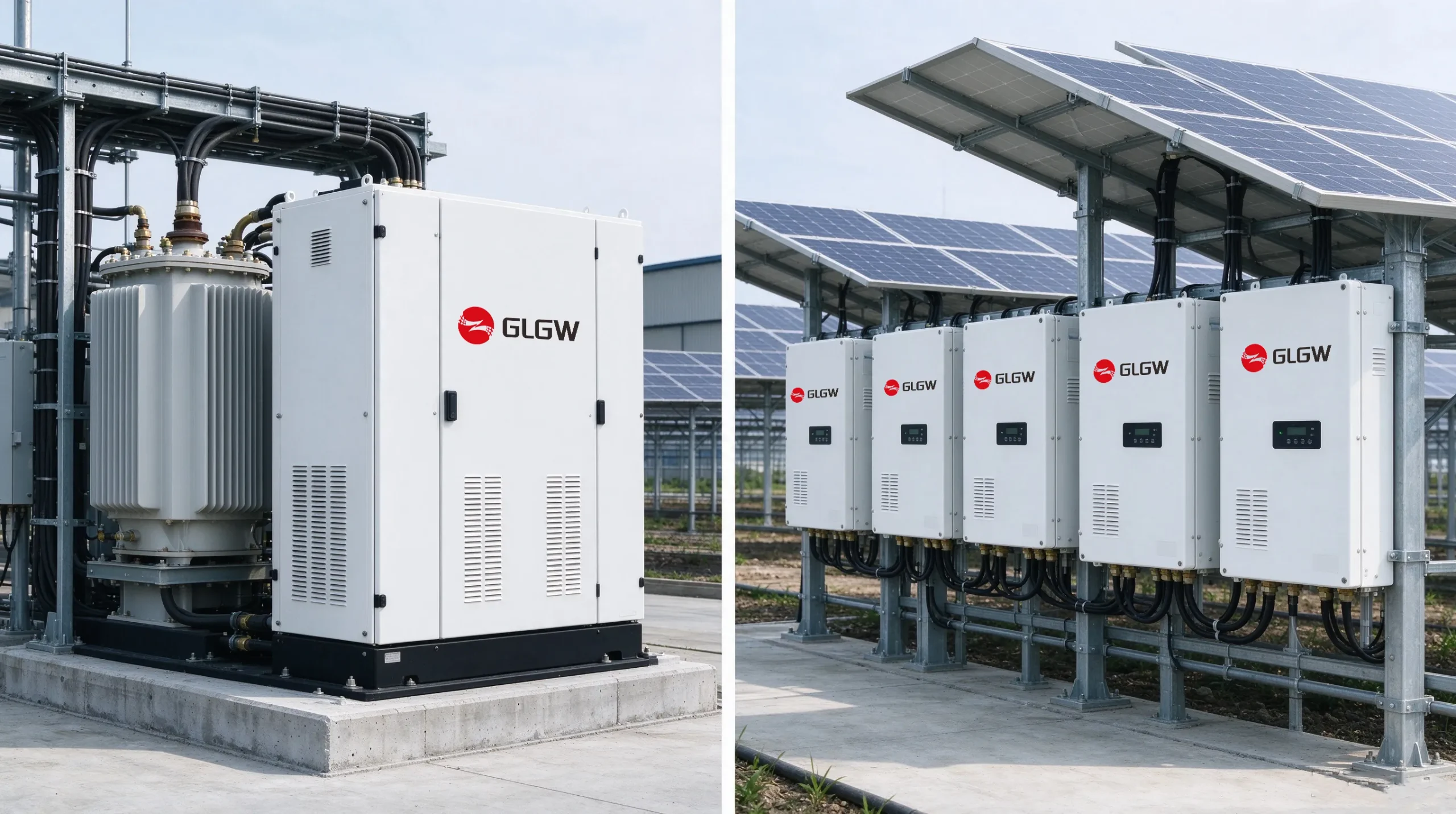
In the financial modeling of utility-scale and large Commercial and Industrial (C&I) solar assets, the selection of the solar inverter architecture is the most consequential engineering decision an EPC (Engineering, Procurement, and Construction) firm will make. While the photovoltaic (PV) modules dictate the theoretical generation capacity, the inverter topology dictates the actualized Levelized Cost of Energy (LCOE) by governing maximum power extraction, system uptime, and lifecycle maintenance expenditures.
For over a decade, the industry debate has centered on a binary choice: the monolithic scale of Central Inverters versus the decentralized agility of String Inverters. Historically, central architectures won on pure upfront capital expenditure (CAPEX) for massive solar farms. However, as advanced silicon carbide (SiC) microelectronics have driven down the cost of distributed power conversion, string architectures have aggressively penetrated the utility-scale market. This B2B technical guide dissects the thermodynamic, electrical, and financial impacts of both architectures, empowering developers to engineer maximum profitability into their solar assets.
1. Central Inverters: The Monolithic Powerhouse
The Central Inverter is the legacy workhorse of the utility-scale solar industry. In this architecture, thousands of solar panels are wired in series to create high-voltage DC strings, which are then routed into heavily fused DC combiner boxes. These combiner boxes channel massive amounts of raw DC power across the facility to a single, centralized megawatt-scale (e.g., 2MW to 5MW) inverter, typically mounted on a reinforced concrete pad alongside a step-up medium-voltage transformer.
Economies of Scale and CAPEX Advantages
The primary advantage of the central architecture is brutal economy of scale. By consolidating the power electronics, cooling systems, and grid-synchronization microprocessors into a single massive enclosure, the cost-per-watt ($/W) of the inverter hardware is significantly lower than buying dozens of smaller units. Furthermore, AC wiring is heavily minimized; because the DC power is brought to a central location, the heavy-gauge AC runs to the grid interconnection point are extremely short, reducing expensive copper cabling costs during the initial CAPEX phase.
The Vulnerability of a Single MPPT
However, this monolithic design harbors a severe operational vulnerability: a lack of granularity. A massive central solar inverter typically utilizes only one or two Maximum Power Point Tracking (MPPT) channels for the entire megawatt array. MPPT algorithms constantly adjust the electrical resistance to extract peak voltage and current. Because thousands of panels are forced to operate on a single MPPT channel, the entire array is electrically homogenized. If a localized cloud shadow, severe soiling, or panel degradation affects just 5% of the array, the single MPPT algorithm is dragged down, artificially suppressing the energy yield of the remaining 95% of perfectly functioning panels.
2. String Inverters: Decentralized Precision
The String Inverter architecture fundamentally deconstructs the central model. Instead of routing the entire solar facility to a single concrete pad, the power conversion is decentralized. The array is segmented into smaller, independent blocks. The DC strings from these panels plug directly into smaller, localized inverters (typically ranging from 50kW to 350kW) that are mounted directly to the solar racking structures or adjacent parapet walls.
Multi-MPPT and Maximum Energy Yield
The definitive engineering advantage of String Inverters is supreme electrical granularity. A modern 200kW commercial string inverter features advanced multi-MPPT architecture, often boasting 9 to 12 independent MPPT channels per unit. If a facility deploys ten of these units, the array is now governed by 120 independent MPPT trackers rather than just one.
This localized tracking is revolutionary for actualized energy yield. If a specific row of panels experiences heavy shading from a nearby tree line or a rooftop HVAC unit, the multi-MPPT algorithm electronically isolates that specific voltage drop to a single channel. The localized shading has absolutely zero electrical impact on the rest of the array. For complex C&I rooftops with multiple pitch angles, orientations, and shading obstacles, this decentralized architecture can increase the total annual kilowatt-hour (kWh) yield by 3% to 7% compared to a central topography.
Eliminating DC Combiner Boxes and Mitigating Fire Risk
Furthermore, deploying String Inverters structurally simplifies the DC wiring topology. Because the solar panel strings plug directly into the localized inverter chassis, the facility completely eliminates the need for large DC combiner boxes and their associated heavy-gauge DC homerun cables. This not only offsets the slightly higher upfront hardware cost of the string architecture but also drastically reduces the risk of undetected DC arc faults—the leading cause of catastrophic solar array fires—improving the overall safety profile of the commercial asset.
3. Operations, Maintenance (O&M), and Redundancy
The most profound divergence between the two architectures lies in their lifecycle Operations and Maintenance (O&M) profiles. When engineering a commercial solar facility for a 20-to-25-year lifespan, assuming hardware will never fail is a disastrous financial model. The true metric of a successful architecture is how rapidly and cheaply a failure can be remediated.
The Centralized Single Point of Failure
Central Inverters introduce a massive single point of failure. If a 2MW central unit experiences a critical fault in its IGBT power module or cooling circuit, the entire 2MW facility is instantly taken offline. The solar array is completely paralyzed, resulting in thousands of dollars of lost revenue (Non-Productive Time or NPT) for every day the unit is down. Remediation is brutal; it frequently requires flying in a specialized OEM technician, renting heavy crane rigging to extract the massive damaged components, and dealing with extensive supply chain lead times for specialized parts.
Modular Swappability and Uptime
Conversely, String Inverters operate on a principle of highly decentralized redundancy. If a facility utilizes twenty 100kW string units and one unit suffers a catastrophic hardware failure, 95% of the solar facility remains entirely online and fully profitable. The O&M response is drastically streamlined. Because string units are relatively lightweight (often under 200 lbs or 90 kg), a standard two-person O&M crew can arrive on-site with a replacement unit in the back of a standard pickup truck. Without the need for heavy cranes or proprietary OEM specialists, the failed unit is unbolted, the new unit is swapped in, and the localized string is back online in under two hours, virtually eliminating devastating plant-level downtime.
Comparative Matrix: Architectural Value Engineering
To assist B2B facility directors and EPC procurement teams in rapid architectural evaluation, the following matrix contrasts the operational and financial dynamics of central versus string topologies.
| Engineering Metric | Central Inverters | String Inverters |
|---|---|---|
| Primary Application | Flat, utility-scale desert solar farms; perfectly uniform arrays. | Complex C&I rooftops; utility-scale arrays with uneven terrain. |
| Hardware CAPEX ($/W) | Lowest upfront capital cost per watt. | Slightly higher initial hardware cost; offsets via BoS savings. |
| Energy Yield (MPPT) | Low granularity. 1-2 MPPTs drag down efficiency during shading. | Supreme granularity. Dozens of MPPTs isolate shading/soiling drops. |
| O&M and Redundancy | Single point of failure. Requires cranes and OEM specialists. | High redundancy. Rapid 2-man swap; zero heavy machinery required. |
| BoS (Balance of System) | Requires expensive DC combiner boxes and heavy DC copper runs. | Eliminates DC combiners; utilizes cheaper, localized AC wiring. |
4. The Shift to 1500V Topologies
Historically, the utility-scale sector operated on a 1000V DC standard. However, to ruthlessly drive down Levelized Cost of Energy (LCOE), the entire industry has transitioned to 1500V DC architectures. Higher voltage allows EPCs to wire up to 50% more solar panels into a single series string, drastically reducing the total number of physical trenches, cables, and connections required across the facility.
Initially, this 1500V transition heavily favored massive Central Inverters, as the sheer size of the high-voltage electrical components required massive enclosures. However, the continuous miniaturization of advanced Silicon Carbide (SiC) power electronics has catalyzed a breakthrough: the 1500V commercial String Inverter. Today, utility-scale developers can deploy 250kW to 350kW string units that natively accept 1500V DC inputs. This technological leap allows EPCs to capture the massive Balance of System (BoS) copper cabling savings of high-voltage architecture, without surrendering the granular multi-MPPT energy yield and rapid O&M swappability that decentralized string architecture provides.
Conclusion: Optimizing LCOE Over Initial CAPEX
The historical debate between Central Inverters and String Inverters is no longer a simple calculation of upfront hardware cost per watt. For a perfectly flat, uniform utility-scale desert facility with zero shading and highly predictable O&M logistics, the central architecture remains a financially viable method for minimizing absolute CAPEX.
However, the modern landscape of commercial solar is increasingly defined by complex rooftops, undulating terrain, and aggressive lifecycle financial modeling. By decentralizing the power conversion, the modern multi-MPPT solar inverter ruthlessly isolates shading losses, maximizing the facility’s daily kilowatt-hour yield. More importantly, it eliminates the catastrophic financial risk of a single point of failure. The ability to rapidly swap a failed string unit with a two-person crew, without cranes or extended plant downtime, drastically slashes lifecycle Operations and Maintenance (O&M) expenditures. For EPCs and facility owners focused on securing the lowest possible Levelized Cost of Energy (LCOE) over a 25-year lifespan, the decentralized agility of the string architecture is increasingly becoming the definitive industry standard.
Frequently Asked Questions (FAQ)
Why do String Inverters yield more energy in shaded conditions than Central Inverters?
A massive central architecture typically relies on only one or two Maximum Power Point Tracking (MPPT) channels for an entire megawatt-scale array. If a small section of the panels is shaded by a cloud or roof obstacle, the single MPPT algorithm drops the voltage for the entire array, artificially suppressing the output of perfectly unshaded panels. String Inverters feature multi-MPPT technology, often boasting dozens of independent trackers across a facility. If one string is shaded, the local solar inverter isolates that specific voltage drop to a single channel, allowing the rest of the commercial array to continue harvesting solar energy at peak efficiency.
What is the O&M difference between Central Inverters and String Inverters during a failure?
The difference lies in redundancy versus a single point of failure. If a 2MW central unit suffers a critical hardware fault, the entire 2MW facility goes completely offline, resulting in massive revenue loss until a specialized OEM technician and heavy cranes arrive to repair the massive unit. Conversely, if a facility uses twenty 100kW String Inverters and one fails, 95% of the plant remains online and profitable. The failed string unit is small and lightweight enough to be quickly unbolted and replaced by a standard two-person maintenance crew in under two hours.
Can String Inverters be used on 1500V utility-scale solar farms?
Yes. While 1500V DC topologies were initially dominated by Central Inverters, the rapid advancement of solid-state power electronics has resulted in the commercialization of high-capacity 1500V string units (ranging from 250kW to 350kW). This allows utility-scale solar developers to achieve the massive copper cabling savings associated with 1500V DC arrays while simultaneously benefiting from the granular energy yield and modular redundancy of a decentralized string architecture.