
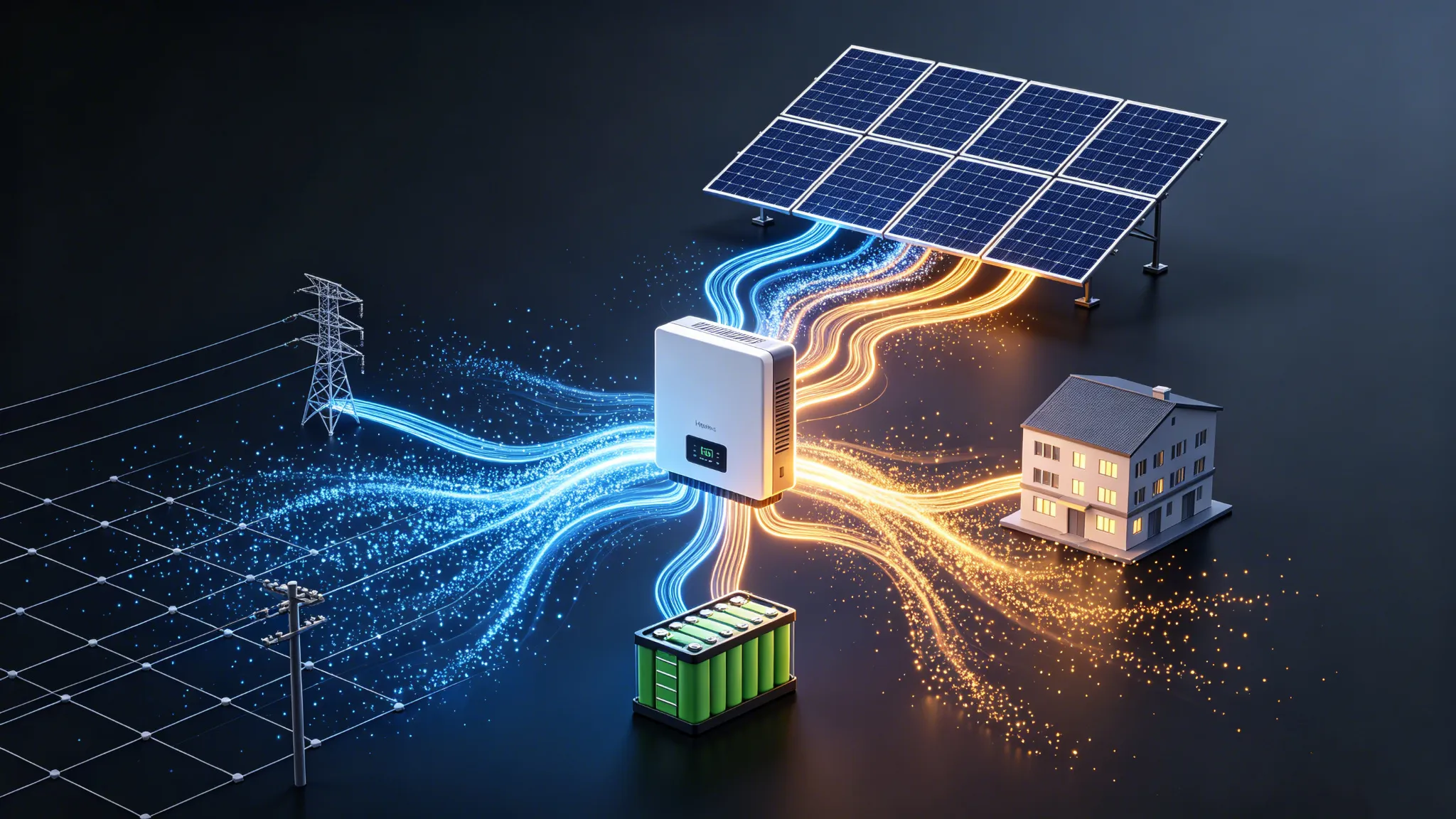
In the rapidly evolving landscape of commercial and residential renewable energy, the strategic objective has shifted from simple utility offset to total energy resilience. As extreme weather events destabilize regional power grids and utility companies aggressively restructure Net Energy Metering (NEM) policies, simply generating solar power is no longer sufficient. Modern microgrids require the ability to capture, store, and dispatch that energy on demand.
At the architectural heart of this transition lies a critical hardware decision for Engineering, Procurement, and Construction (EPC) firms and facility directors: selecting the correct power conversion topology. When designing a system that includes Battery Energy Storage Systems (BESS), the choice between a standard grid-tied inverter and an advanced Hybrid Solar Inverter dictates the project’s thermodynamic efficiency, operational capabilities during a blackout, and total Levelized Cost of Storage (LCOS). This technical brief deconstructs the engineering mechanics of both architectures to determine which system is superior for modern energy storage deployments.
Understanding the Baseline: The Grid-Tied Inverter
For the past two decades, the grid-tied inverter (often referred to as a string inverter or standard solar inverter) has been the undisputed workhorse of the solar industry. Its engineering mandate is singular and highly specialized: to take the high-voltage Direct Current (DC) electricity generated by the photovoltaic (PV) array and invert it into Alternating Current (AC) electricity that perfectly matches the voltage and phase of the commercial utility grid.
Because these inverters are “grid-following” devices, they rely entirely on the utility grid’s presence to set the electrical frequency (e.g., 60Hz in North America). If the utility grid fails, strict anti-islanding regulations (such as UL 1741 and IEEE 1547) mandate that a grid-tied inverter must shut down in milliseconds. This safety feature prevents the solar array from back-feeding lethal AC power into dead power lines where utility linemen are working. Consequently, if a facility relies solely on a grid-tied inverter, a massive, fully functional solar array becomes completely useless the moment a grid blackout occurs.
The Retrofit Problem: AC-Coupled Storage
Crucially, standard grid-tied inverters cannot communicate with or natively charge a DC battery bank. If a developer wants to add storage to an existing grid-tied system, they must utilize an “AC-Coupled” architecture. This requires installing a completely separate, dedicated battery inverter. This dual-inverter setup forces the electricity to undergo three separate inversions (DC to AC from the roof, AC to DC into the battery, and DC to AC back to the facility). This thermodynamic “conversion penalty” degrades the overall system Round-Trip Efficiency (RTE) by 10% to 15%, resulting in significant long-term energy loss.
The Engineering Evolution: The Hybrid Solar Inverter
A Hybrid Solar Inverter is a highly advanced piece of power electronics that fundamentally solves the limitations of the grid-tied topology. It integrates the functionality of a standard solar inverter and a sophisticated battery charge controller into a single, unified hardware chassis.
This hardware integration enables a highly efficient “DC-Coupled” architecture. When the solar panels generate DC power, the Hybrid Solar Inverter acts as an intelligent energy router. It can invert the power to AC for immediate facility consumption, export excess AC to the grid, or—most importantly—route the electricity in its native DC state directly into the battery bank for storage.
By bypassing the AC inversion phase entirely when charging batteries, the Hybrid Solar Inverter eliminates the severe thermodynamic losses associated with AC-coupled systems. This direct DC-to-DC transfer allows modern hybrid storage architectures paired with high-capacity lithium-ion cells to achieve exceptional Round-Trip Efficiencies (RTE) exceeding 96%. Over the 20-year operational lifecycle of a commercial asset, this maximized efficiency directly translates to a lower Levelized Cost of Energy (LCOE).
Advanced Capabilities: Grid-Forming and Total Resilience
Beyond thermodynamic efficiency, the true value of a Hybrid Solar Inverter lies in its advanced operational software and integrated hardware switches, which fundamentally alter how a facility interacts with the utility grid.
Island Mode and Blackout Protection
Unlike standard grid-tied inverters that shut down during an outage, advanced hybrid inverters feature internal Automatic Transfer Switches (ATS) and “grid-forming” capabilities. The moment the utility grid drops, the Hybrid Solar Inverter detects the loss of voltage and mechanically disconnects the facility from the grid in milliseconds. It then establishes its own localized electrical grid (an “island”). This allows the solar panels to continue generating power, feeding critical facility loads and recharging the battery bank simultaneously, completely independent of the utility company.
Peak Shaving and TOU Arbitrage
For Commercial and Industrial (C&I) facilities, utility bills are heavily dictated by peak demand charges and Time-of-Use (TOU) rates. A grid-tied inverter simply pushes solar energy into the building as it is generated, offering no control over when that energy is deployed.
Conversely, a Hybrid Solar Inverter acts as an intelligent financial manager. By monitoring facility load and utility pricing algorithms in real-time, the inverter can store solar energy during cheap morning hours and strategically discharge the battery during peak afternoon pricing windows. Furthermore, if a heavy piece of industrial machinery turns on and threatens to spike the facility’s demand charge, the hybrid system instantly injects battery power to “shave” the peak, saving thousands of dollars in utility penalties.
DC Oversizing and Clipping Recovery
To maximize financial return, solar arrays are routinely “oversized” relative to the inverter’s maximum AC output rating (often by a ratio of 1.3 to 1). On a perfectly clear day at noon, the solar panels generate more DC power than the inverter can convert to AC. A standard grid-tied inverter simply “clips” this excess power, losing it entirely as waste heat.
A Hybrid Solar Inverter capitalizes on this excess generation. Because it features a direct DC-coupled pathway to the battery, it captures the clipped DC power that would otherwise be wasted and routes it directly into the storage bank. Over the lifespan of a large commercial array, this clipping recovery translates to megawatt-hours of additional harvested energy.
Comparative Matrix: Evaluating Inverter Architectures
To assist procurement directors and EPC engineers in value engineering their solar storage packages, the following matrix contrasts the critical operational metrics of both inverter topologies.
| Engineering Metric | Standard Grid-Tied Inverter | Hybrid Solar Inverter (DC-Coupled) |
|---|---|---|
| Primary Architectural Function | Unidirectional DC to AC conversion only. | Bi-directional power routing (DC to AC, AC to DC, DC to DC). |
| Blackout Operation (Grid-Forming) | None. Must shut down immediately per anti-islanding codes. | Excellent. Isolates facility and provides continuous backup power. |
| Energy Storage Integration | Requires a separate AC-coupled battery inverter (high CAPEX). | Native DC-coupled battery integration built-in. |
| System Round-Trip Efficiency (RTE) | Lower (~85%-90%) due to triple-conversion penalty. | Maximum (~95%-97%) via direct DC-to-DC charging. |
| Clipping Recovery (DC Oversizing) | Impossible. Excess midday generation is permanently lost. | High. Excess DC generation is rerouted directly to batteries. |
The Retrofit Exception: When AC-Coupling Still Makes Sense
Despite the overwhelming technical superiority of DC-coupled hybrid systems for new construction, the standard grid-tied inverter remains highly relevant in one specific commercial scenario: the storage retrofit. Millions of commercial and residential properties installed massive grid-tied solar arrays five to ten years ago. These legacy string inverters are still fully operational and generating reliable power.
If a facility director decides to add an energy storage system to an existing, operational grid-tied array, ripping out the legacy inverters to install new hybrid units represents a massive, often unjustifiable Capital Expenditure (CAPEX). In this retrofitting scenario, utilizing an AC-coupled architecture is the most pragmatic financial choice. The EPC simply installs a standalone battery bank paired with a dedicated AC-coupled battery inverter, tapping into the existing electrical panel without dismantling the original solar hardware.
However, for any new (“greenfield”) construction, or if a facility is replacing end-of-life legacy inverters, specifying a traditional grid-tied system when energy storage is in the project pipeline is a profound engineering misstep that permanently handicaps the asset’s thermodynamic efficiency.
Conclusion: The Definitive Choice for Solar Energy Storage
The global transition from simple solar generation to dispatchable energy resilience has rendered the traditional, unidirectional grid-tied inverter technologically obsolete for modern microgrids. When evaluating the power conversion architecture for a new Solar Energy Storage System, the Hybrid Solar Inverter is the definitive engineering solution.
By establishing a highly efficient DC-coupled topology, hybrid systems eliminate the severe conversion penalties associated with AC-coupled retrofits, driving Round-Trip Efficiency (RTE) toward theoretical maximums. Furthermore, by consolidating hardware, enabling seamless grid-forming backup power, and executing sophisticated peak-shaving algorithms to combat volatile utility rates, the Hybrid Solar Inverter acts as the intelligent core of the commercial microgrid. It maximizes the asset’s financial yield, ensures operational continuity during blackouts, and secures the facility’s total energy independence.
Frequently Asked Questions (FAQ)
Can I install a hybrid solar inverter now and add batteries later?
Yes. This is one of the greatest strategic advantages of the technology. The vast majority of tier-one hybrid solar inverters are designed to be “storage-ready.” They function perfectly as standard grid-tied inverters from day one, allowing a facility to immediately begin generating solar power and offsetting utility costs. Months or years later, when capital budgets permit or utility net-metering policies change, the facility can simply plug in a compatible DC battery bank without needing to replace or upgrade the central inverter hardware.
Are hybrid solar inverters significantly more expensive than standard grid-tied inverters?
While the initial capital expenditure (CAPEX) for a single Hybrid Solar Inverter is higher than a comparable grid-tied string inverter, evaluating the cost in isolation is a financial fallacy. If your project includes energy storage (now or in the future), the hybrid approach is vastly cheaper. Purchasing a hybrid inverter is significantly more cost-effective than purchasing a cheap grid-tied inverter today, and then being forced to buy an expensive, secondary AC-coupled battery inverter a few years later.
Do I need a hybrid system if my utility company offers 1:1 Net Energy Metering (NEM)?
If your utility guarantees 1:1 retail net metering (where they pay you the exact same rate for the solar power you export as they charge you for the power you consume at night), a battery storage system offers minimal financial ROI, and a standard grid-tied inverter is highly cost-effective. However, utility commissions globally are rapidly dismantling 1:1 NEM policies, replacing them with aggressive Time-of-Use rates and low export compensation (e.g., NEM 3.0 in California). As these policies degrade, a Hybrid Solar Inverter paired with storage becomes mandatory to protect the financial viability of the solar asset.