
As the global industrial sector accelerates its transition toward renewable power and electrification, the demand for robust, high-capacity utility and commercial infrastructure is at an all-time high. At the heart of this transition are Batteries—the critical components that dictate the efficiency, safety, and financial viability of any localized microgrid or utility-scale project. For years, one technology has dominated this space, but a new, disruptive architecture is rapidly approaching commercialization.
For Engineering, Procurement, and Construction (EPC) firms, facility directors, and B2B energy consultants, understanding the technological trajectory of Energy Storage is no longer optional; it is a prerequisite for future-proofing capital investments. The core debate shaping the next decade of power management is the comparison between conventional lithium-ion systems and emerging solid-state alternatives.
This comprehensive guide breaks down the fundamental engineering differences, performance metrics, and commercial implications of these two distinct technologies, providing actionable insights for your next large-scale procurement cycle.
Understanding the Foundational Architecture
To grasp the differences between these two technologies, we must first understand how electrical current is generated and stored at a chemical level. In any battery cell, energy is discharged when lithium ions travel from the negative electrode (the anode) to the positive electrode (the cathode). When the battery is charging, the flow reverses. The medium through which these ions travel is called the electrolyte.
The Anatomy of Lithium-Ion Systems
Since their commercial introduction in the 1990s, lithium-ion systems have been the undisputed backbone of modern portable electronics, electric vehicles (EVs), and commercial Energy Storage systems (ESS). Their architecture relies on a liquid component.
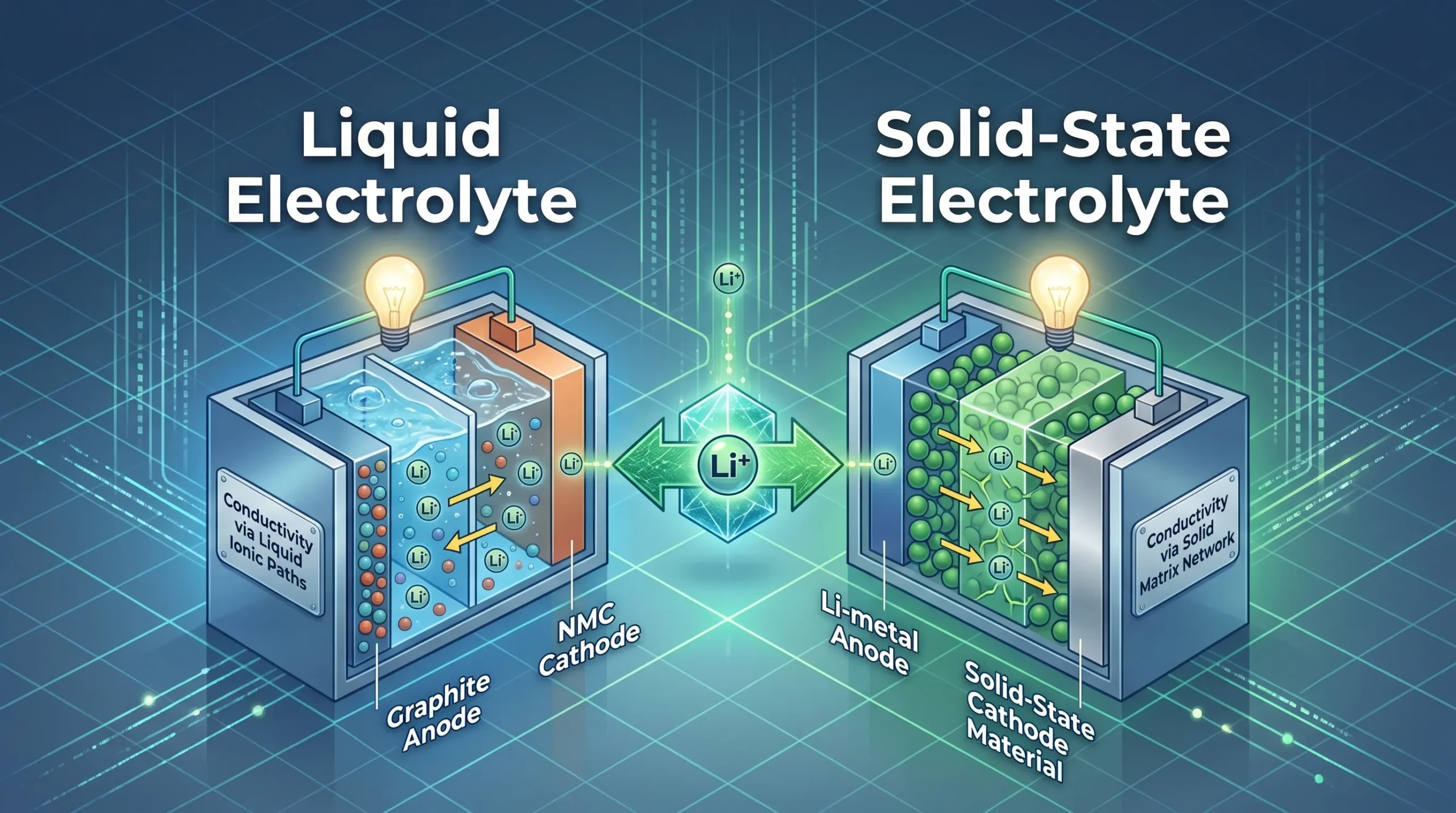
- Liquid Electrolyte: In a traditional lithium-ion cell, the electrolyte is a liquid solution containing lithium salts dissolved in organic solvents. This liquid allows for excellent ionic conductivity, meaning ions can move quickly and easily between the anode and cathode.
- The Porous Separator: Because the electrolyte is a liquid, a physical polymer separator (a micro-porous membrane) must be placed between the anode and cathode. This separator allows ions to pass through while preventing the two electrodes from physically touching, which would cause a catastrophic short circuit.
- The Vulnerability (SEI Layer & Dendrites): The organic liquid electrolyte is inherently highly flammable. Over thousands of cycles, lithium can accumulate unevenly on the anode, forming microscopic, needle-like structures called dendrites. If a dendrite grows long enough to pierce the polymer separator, it creates an internal short circuit, leading to a dangerous chemical chain reaction known as thermal runaway.
The Anatomy of Solid-State Systems
Solid-state technology represents a paradigm shift in cell architecture. As the name implies, it entirely eliminates the liquid organic solvents and the porous polymer separator, replacing them with a single, solid conductive material.
- The Solid Electrolyte: In these advanced cells, ions travel through a solid matrix. Current research and manufacturing focus on three primary materials for this solid electrolyte: inorganic ceramics (like oxides and sulfides), solid polymers, or composite materials.
- Dendrite Suppression: A rigid solid electrolyte acts as an impenetrable physical barrier. It fundamentally suppresses the formation and penetration of lithium dendrites. This allows engineers to safely utilize pure lithium metal as the anode (rather than the graphite used in conventional cells).
- The Ionic Conductivity Challenge: The primary historical hurdle for solid-state technology has been the fact that ions generally move slower through a solid than through a liquid, especially at room temperature. However, recent breakthroughs in sulfide-based solid electrolytes have achieved ionic conductivities that rival or even exceed their liquid counterparts.
Key Differences: A Comparative Analysis for Commercial Projects
When evaluating these technologies for integration into industrial Energy Storage, procurement teams must look beyond basic chemistry and focus on operational KPIs (Key Performance Indicators). The shift from liquid to solid electrolytes profoundly alters the performance profile of the battery bank.
| Performance Metric | Lithium-Ion (Liquid Electrolyte) | Solid-State (Solid Electrolyte) |
|---|---|---|
| Energy Density (Wh/kg) | Moderate to High (typically 200–300 Wh/kg). Limited by the weight of graphite anodes and liquid cooling systems. | Extremely High (projected 400–500+ Wh/kg). Enabled by the use of lithium-metal anodes and denser cell packing. |
| Safety Profile | Requires active thermal management (HVAC/liquid cooling). Susceptible to thermal runaway and highly flammable. | Inherently non-flammable. Eliminates the risk of liquid electrolyte leakage and severely limits thermal runaway risks. |
| Cycle Life & Degradation | Subject to gradual capacity fade due to continuous Solid Electrolyte Interphase (SEI) layer growth and liquid depletion. | Potentially much longer cycle life. Solid electrolytes do not experience the same parasitic side reactions as liquids. |
| Operating Temperature Range | Narrow optimal window (typically 15°C to 35°C). Requires heating in freezing climates and intense cooling in hot environments. | Broad operational window. Can operate efficiently at extreme temperatures (-30°C to 100°C) without complex external thermal management. |
(End of Part 1. The following sections will cover the deep implications for commercial footprint, B2B procurement strategies, market readiness, and the timeline for widespread industrial adoption.)
Transforming the Industrial Footprint: Balance of System (BOS) Impacts
When facility managers and EPC contractors allocate real estate for a commercial-scale Energy Storage system, the physical dimensions of the battery cells themselves represent only a fraction of the total footprint. The true spatial requirements are dictated by the necessary auxiliary systems, collectively known as the Balance of System (BOS). The transition from liquid to solid electrolytes fundamentally alters this BOS equation, presenting massive spatial and financial advantages for industrial deployments.
The Burden of Active Thermal Management
Conventional lithium-ion Batteries are highly sensitive to temperature fluctuations. Operating them outside their optimal thermal window (typically 15°C to 35°C) accelerates degradation and significantly increases the risk of thermal runaway. Consequently, a standard megawatt-scale lithium-ion container requires a robust, energy-intensive HVAC (Heating, Ventilation, and Air Conditioning) or liquid-cooling system. These thermal management systems consume a portion of the energy they are meant to store (known as parasitic load) and require constant mechanical maintenance.
Because solid-state architectures utilize non-flammable, highly stable solid electrolytes, their tolerance for extreme temperatures is vastly superior. They can safely operate at higher voltages and temperatures without the immediate threat of catastrophic failure. This allows engineers to drastically downsize, or entirely eliminate, complex active cooling systems. The removal of HVAC units and liquid coolant pumps frees up significant internal volume, allowing for denser cell packing and a smaller overall container footprint on the factory floor.
Navigating NFPA 855 and Fire Suppression Mandates
For industrial facilities in North America, installing localized power systems means adhering to strict fire safety codes, most notably NFPA 855 (Standard for the Installation of Stationary Energy Storage Systems). Due to the highly flammable nature of organic liquid electrolytes, lithium-ion installations require extensive fire suppression infrastructure (such as clean agent gas or high-pressure water mist systems), deflagration venting, and mandated physical setback distances from primary buildings to prevent fire propagation.
Solid-state technology has the potential to rewrite these compliance standards. By removing the combustible liquid fuel source from the equation, solid-state cells are inherently resistant to fire, even when subjected to physical puncture, overcharging, or external heat. As this technology reaches commercial maturity, it is highly anticipated that regulatory bodies will relax the setback and fire suppression requirements for solid-state deployments, allowing for easier permitting and integration into densely packed urban manufacturing centers.
The Economics of Procurement: CAPEX vs. OPEX Realities
From a Chief Financial Officer’s (CFO) perspective, the choice between these two technologies hinges on the Total Cost of Ownership (TCO) modeled over a 15- to 20-year lifespan. This requires a nuanced analysis of upfront Capital Expenditure (CAPEX) versus ongoing Operational Expenditure (OPEX).
Lithium-Ion: The Advantage of Unprecedented Scale
Currently, traditional lithium-ion technology holds an overwhelming CAPEX advantage. Driven by a decade of aggressive investments from the electric vehicle (EV) sector, global manufacturing capacity has reached the terawatt-hour (TWh) scale. This massive economy of scale has driven the cost of lithium-ion cells down by over 80% over the last decade. For immediate deployments, lithium-ion remains the most financially viable and proven technology available on the open market.
However, this low initial CAPEX is offset by higher OPEX. Facility managers must budget for continuous HVAC maintenance, regular software diagnostics, capacity augmentation (adding new cell racks in year 7 or 8 to compensate for degradation), and high insurance premiums associated with fire risks.
Solid-State: The Promise of Zero-Maintenance OPEX
Solid-state Batteries are currently in the pilot manufacturing phase, meaning their initial CAPEX is significantly higher than conventional cells. The manufacturing processes require entirely new dry-room environments and specialized pressing equipment to ensure perfect contact between the solid layers.
Despite the high initial price tag, the OPEX profile of a solid-state system is highly attractive. The elimination of liquid cooling maintenance, drastically reduced fire insurance premiums, and a projected lifespan that could exceed 10,000 cycles without significant capacity fade means that over a 20-year period, a solid-state system could deliver a vastly superior Levelized Cost of Storage (LCOS). They represent a “deploy and forget” asset class that is highly sought after by utility operators.
Market Readiness and the Commercialization Timeline
When planning a corporate sustainability roadmap, timing the procurement cycle is everything. Adopting a technology too early exposes the facility to prototype risks, while adopting it too late means missing out on competitive operational advantages.
The Current State of the Industry
As of the mid-2020s, lithium-ion technology is at a Technology Readiness Level (TRL) of 9—it is fully mature, bankable, and dominating global deployments. Conversely, large-scale, high-capacity solid-state cells are hovering around TRL 6 to 7. While smaller solid-state cells have been used for years in medical devices (like pacemakers) and RFID tags, scaling the manufacturing process to produce the massive prismatic or pouch cells required for grid storage has proven to be a formidable engineering challenge.
Leading automotive OEMs (like Toyota, Volkswagen, and BMW) have poured billions into solid-state startups (such as QuantumScape and Solid Power) to accelerate development for EVs. Historical trends dictate that advancements in EV battery technology typically cascade into the stationary storage market 3 to 5 years later, once the initial manufacturing constraints are resolved and the supply chain matures.
(End of Part 2. The final section will provide actionable advice for B2B procurement strategies, supply chain considerations, and the final FAQ and structural data.)
Strategic Procurement: Navigating the 2026-2030 Transition Period
Given the current technological landscape, facility directors face a strategic dilemma: invest heavily in mature lithium-ion systems today, or delay procurement in anticipation of next-generation solid-state architectures. For B2B organizations aiming to secure energy resilience and reduce demand charges in the near term, waiting is not a financially sound strategy. The lost utility savings and the ongoing risk of operational downtime far outweigh the theoretical benefits of waiting for a technology that is still years away from utility-scale commercialization.
The “Bridge” Strategy: Modular and Agnostic Inverter Design
The most pragmatic approach for EPCs and facility engineers is to adopt a “bridge” procurement strategy. This involves deploying lithium-ion Energy Storage today, but designing the Balance of System (BOS)—specifically the Power Conversion System (PCS) and the microgrid controller—to be chemistry-agnostic.
By selecting smart inverters equipped with ultra-wide DC voltage windows and utilizing advanced Energy Management Systems (EMS) that operate on open-source protocols, facilities can future-proof their infrastructure. When the first-generation lithium-ion cell racks reach their end-of-life (typically in 10 to 12 years), the facility can seamlessly swap out the liquid-based cells for solid-state modules without having to rip and replace the expensive inverters, switchgear, or control software.
Evaluating Vendor Bankability and Warranty Horizons
When drafting Requests for Proposals (RFPs) for large-scale Batteries, procurement teams must strictly evaluate the financial bankability of the Tier 1 supplier. Performance guarantees and warranty horizons (often spanning 15 to 20 years) are only as valuable as the balance sheet of the company backing them. As the industry anticipates the disruptive arrival of solid-state manufacturers, market consolidation is inevitable. Ensure that current lithium-ion vendors have clear roadmap strategies for integrating or transitioning to solid-state manufacturing, guaranteeing long-term O&M (Operations and Maintenance) support.
Supply Chain Implications and ESG Compliance
Beyond technical performance, the shift from liquid to solid electrolytes carries massive implications for global supply chains and corporate ESG (Environmental, Social, and Governance) reporting.
Traditional lithium-ion systems are heavily reliant on critical minerals like cobalt and nickel for their cathodes. The extraction of these minerals often presents severe ethical and geopolitical supply chain risks. Solid-state technology, particularly those utilizing lithium-metal anodes and sulfide-based solid electrolytes, fundamentally alters the Bill of Materials (BOM). While they require significantly more pure lithium, they often engineer out the need for controversial elements like cobalt entirely.
For large-scale industrial buyers, this means solid-state technology will eventually offer a much cleaner, more transparent supply chain, making it significantly easier to meet strict scope 3 emissions targets and comply with emerging international regulations regarding conflict minerals.
Conclusion: The Verdict on Next-Generation Storage
The difference between lithium-ion and solid-state architectures is not merely an incremental update; it is a fundamental redesign of how chemical energy is safely housed and deployed. Lithium-ion, with its liquid electrolyte, is the undisputed workhorse of the current energy transition—offering unbeatable economies of scale, proven reliability, and immediate availability. However, it is inherently limited by its thermal volatility and spatial requirements.
Solid-state technology represents the holy grail of localized power: immense energy density, inherent fire safety, and a drastically reduced physical footprint. While it is currently navigating the “valley of death” between laboratory prototypes and mass manufacturing, its commercial arrival in the early 2030s will permanently alter the landscape of industrial power management. Until then, proactive facility leaders must leverage modular, forward-compatible lithium-ion systems to capture immediate ROI, while strategically positioning their infrastructure to adopt solid-state advancements the moment they achieve commercial viability.
Frequently Asked Questions (FAQ)
Are solid-state batteries currently available for commercial microgrids?
As of now, no. While solid-state technology is being aggressively piloted in the electric vehicle (EV) sector, megawatt-scale solid-state cells designed specifically for stationary grid storage are not yet commercially available for mass procurement. The industry expects stationary storage applications to reach commercial maturity 3 to 5 years after the EV market achieves scale.
Will solid-state battery systems be 100% fireproof?
While no electrical system containing highly dense stored energy is completely immune to catastrophic failure, solid-state cells are classified as inherently non-flammable. By removing the volatile, combustible liquid organic solvent found in lithium-ion cells, the primary fuel source for thermal runaway is eliminated. This makes them exponentially safer and will likely drastically reduce the required fire suppression infrastructure for indoor industrial deployments.
Should I wait for solid-state technology or invest in a lithium-ion system now?
You should not wait. Delaying an energy storage project means losing out on immediate, tangible utility savings (peak shaving and load shifting) and leaving your facility vulnerable to grid outages. The industry best practice is to deploy lithium-ion systems today using chemistry-agnostic inverters, allowing you to easily retrofit with solid-state cells when your initial battery racks reach the end of their lifecycle.